

Solvent Based
Solvent-based adhesive technology remains a proven choice where fast grab, high bond strength, demanding temperature performance and dependable processing are critical.
At Vola Group, our solvent-based portfolio spans a broad range of chemistries and application profiles, from traditional rubber and resin contact adhesives through to high-performance polyurethane systems and specialist high-tack formulations. Products can be engineered for contact bonding, single-sided application, permanent assembly and applications where rapid initial tack is essential to production efficiency.
Rubber & Resin Systems
High-strength, fast-grab, proven in the field.
Our rubber and resin-based adhesives are designed to deliver rapid tack development, strong initial grab and reliable permanent bonding across a wide variety of substrates. Formulations can be developed for contact application or single-sided processes, with tackifier and resin systems tailored to achieve the required balance of open time, grab, bond strength and heat performance.
These technologies are widely suited to applications where components need to be positioned, bonded and moved quickly through production without compromising final bond integrity.
Polyurethane Solvent-Based Systems
For more demanding applications, our polyurethane solvent-based adhesives provide enhanced bond durability, temperature resistance and performance across challenging substrates. These systems are particularly suited to applications requiring a combination of high final strength, flexibility and resistance to elevated service temperatures.
From fast-grab production adhesives to technically demanding permanent bonding systems, Vola Group develops solvent-based technologies around the substrate, application method, production environment and required end-use performance.
The result is not simply a solvent-based adhesive, but the right chemistry, tack profile and performance characteristics for the process it has to work in.
Scored 0 to 100 against the Vola range. Higher is stronger.
| Carrier | Organic solvent blend |
|---|---|
| Polymer base | Synthetic rubber with tackifying resin |
| Bond type | Contact, both faces coated, with extended working time on rubber & resin grades |
| Heat resistance | Up to 250°C |
| Substrates | Metal, timber, laminate, membrane, foam, board, insulation, flexible sheet and many more |
| Working time | Grade dependent, up to 30 minutes |
| Restrictions | Legislation is jurisdiction dependent. Substances of Very High Concern (SVHCs) are substances we work to mitigate, and Dichloromethane (DCM) free formulations are available |
Can sheets be repositioned after bonding?⌄
Repositionability is very limited. These are contact adhesives, so the solvent flashes off quickly and the bond grabs on contact. Position the sheet before it goes down rather than after.
Are solvent-based adhesives being phased out?⌄
No, but specific solvents are restricted. We reformulate to remove restricted substances while holding performance.
How much ventilation is needed?⌄
Application requires extraction or open-air working. Method statements are issued with the product.
Water Based
Lower emissions, cleaner working, no compromise on coverage.
Water-based emulsions carry the polymer in water rather than solvent, cutting volatile organic compound (VOC) content and making indoor application far easier to manage.
Scored 0 to 100 against the Vola range. Higher is stronger.
| Carrier | Water, aqueous emulsion |
|---|---|
| Bond type | Wet or contact, depending on grade |
| Heat resistance | Up to 120°C |
| Substrates | Timber, board, textile, foam, porous membrane and many other substrates |
| VOC | Below 5 g/litre |
Will it work in cold conditions?⌄
Application above 5°C is required. Cure slows significantly in cold, damp conditions.
Is coverage lower than solvent based?⌄
Comparable per litre on porous substrates; solids content is the deciding factor, not the carrier.
Epoxy
Sprayable epoxy systems
Tack that will not fight the resin.
Vola's epoxy offer is sprayable epoxy, not a structural adhesive. The underlying technology is two component, but it is supplied and handled as a single component: no on-site mixing, no pot life to manage, sprayed straight from the can or canister.
Its purpose is holding dry fabric and core materials in position during epoxy-based infusion work. Because it is epoxy compatible, it will not inhibit resin flow, contaminate the laminate or interfere with cure, which is what rules out most general-purpose tackifiers on infusion projects.
Scored 0 to 100 against the Vola range. Higher is stronger.
| Technology | Two component based, classified and supplied as single component |
|---|---|
| Mixing | None. No pot life to manage on site |
| Function | Holding dry fabric and core in position ahead of infusion |
| Process compatibility | Epoxy-based infusion, resin transfer moulding (RTM), vacuum bagging |
| Substrates | Glass, carbon and aramid fabrics, core materials, mould tooling |
| Resin effect | Does not inhibit resin flow, wet-out or cure |
Is this a structural epoxy adhesive?⌄
No. It is a sprayable epoxy tackifier for holding materials in position during infusion. The structural strength comes from the infusion resin, not from this product.
If it is two component, why is there no mixing?⌄
The two component chemistry is handled in manufacture. On site it behaves as a single component product, which is how it is classified and supplied.
MS Polymer
Bonds and seals without solvent or isocyanate.
Modified silane (MS) polymer cures with ambient moisture to a flexible, durable bond, with no solvent and no isocyanate content. That makes it well suited to enclosed environments and to applications where the joint has to move.
Scored 0 to 100 against the Vola range. Higher is stronger.
| Base | Modified silane (MS) polymer |
|---|---|
| Cure | Ambient moisture cure |
| Content | Solvent free and isocyanate free |
| Bond type | Flexible bonding |
| Substrates | Metal, composite, glass, timber, most plastics |
Why choose MS Polymer over polyurethane?⌄
Mainly for VOC reasons, and for internal applications in live environments where people are present.
Does it need a primer?⌄
Most substrates need none. Confirm per substrate with the technical team.
Polyurethane Systems
Built to absorb movement, not to stretch.
Polyurethane systems cure to a tough, durable bond with high resistance to weather, temperature and sustained load. The important property is movement tolerance: the bond accommodates the expansion and contraction that external environments put through a joint as temperature and climate change, without breaking down. It is not an elastomeric adhesive like a silicone or MS Polymer, which allow for elongation. It is designed for structural bonding applications in construction and industrial markets.
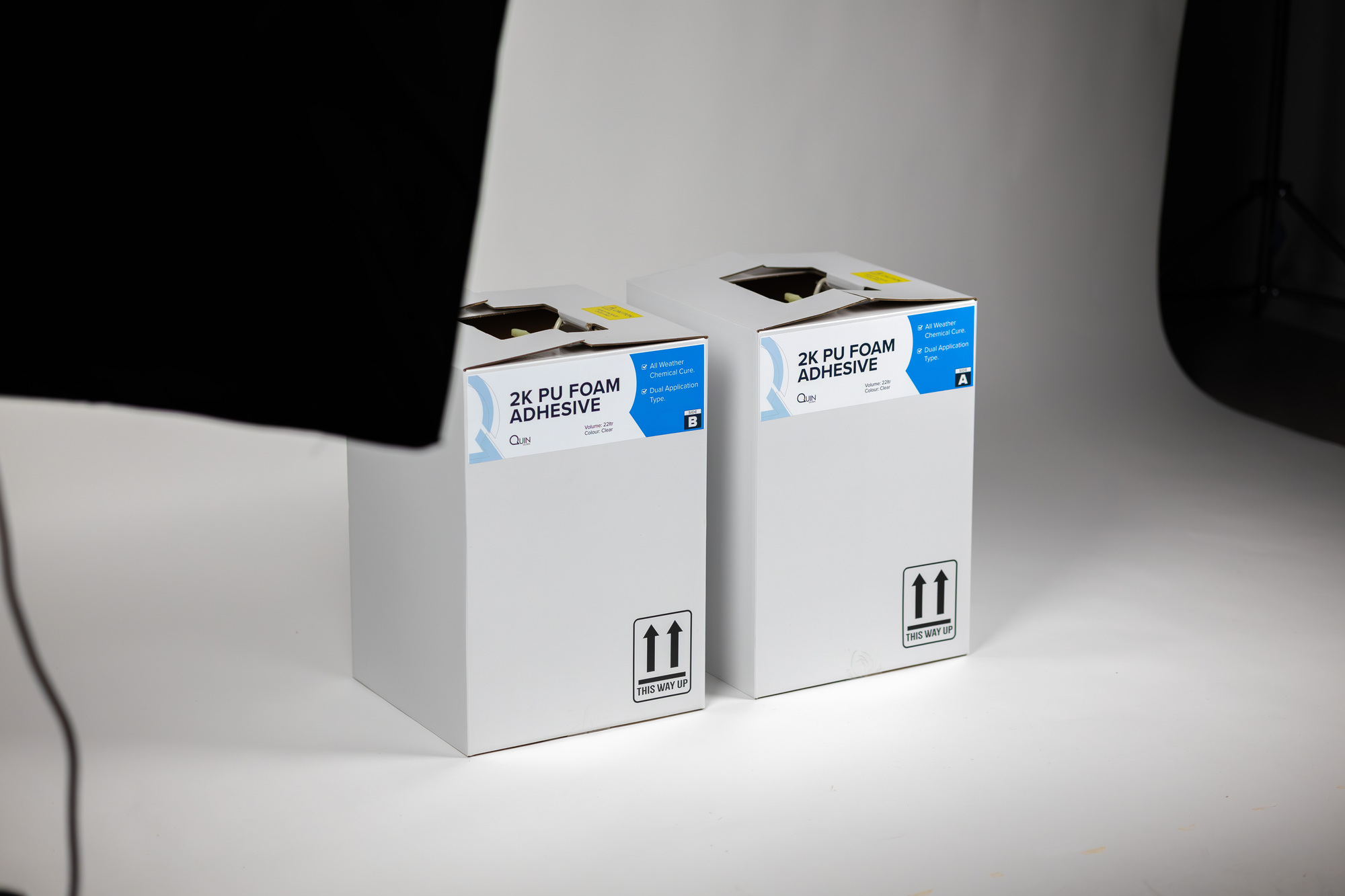
Supplied as one-component grades that cure with ambient moisture, and two-component grades that cure on mix and are independent of site conditions.
How that chemistry reaches the substrate is covered under technologies: see 1K & 2K PU Bead / Fan Spray System for the application side, including when to specify 1K over 2K.
Scored 0 to 100 against the Vola range. Higher is stronger.
| Base | Polyurethane, one and two component |
|---|---|
| Cure | Moisture cure (1K) or chemical cure on mix (2K) |
| Bond type | Structural and semi-structural, tolerant of substrate movement |
| Heat resistance | Confirm per grade |
| Substrates | Timber, metal, concrete, composite, board, insulation |
| Formats | Bead or fan spray, canister |
When should I choose 2K over 1K?⌄
When cure cannot depend on ambient humidity, or when a faster, more predictable cure is required.
How flexible is the cured bond?⌄
Not in the elastomeric sense. It will not elongate like a silicone or MS Polymer sealant. What it does is absorb the expansion and contraction of substrates in external environments without the bond breaking down.